

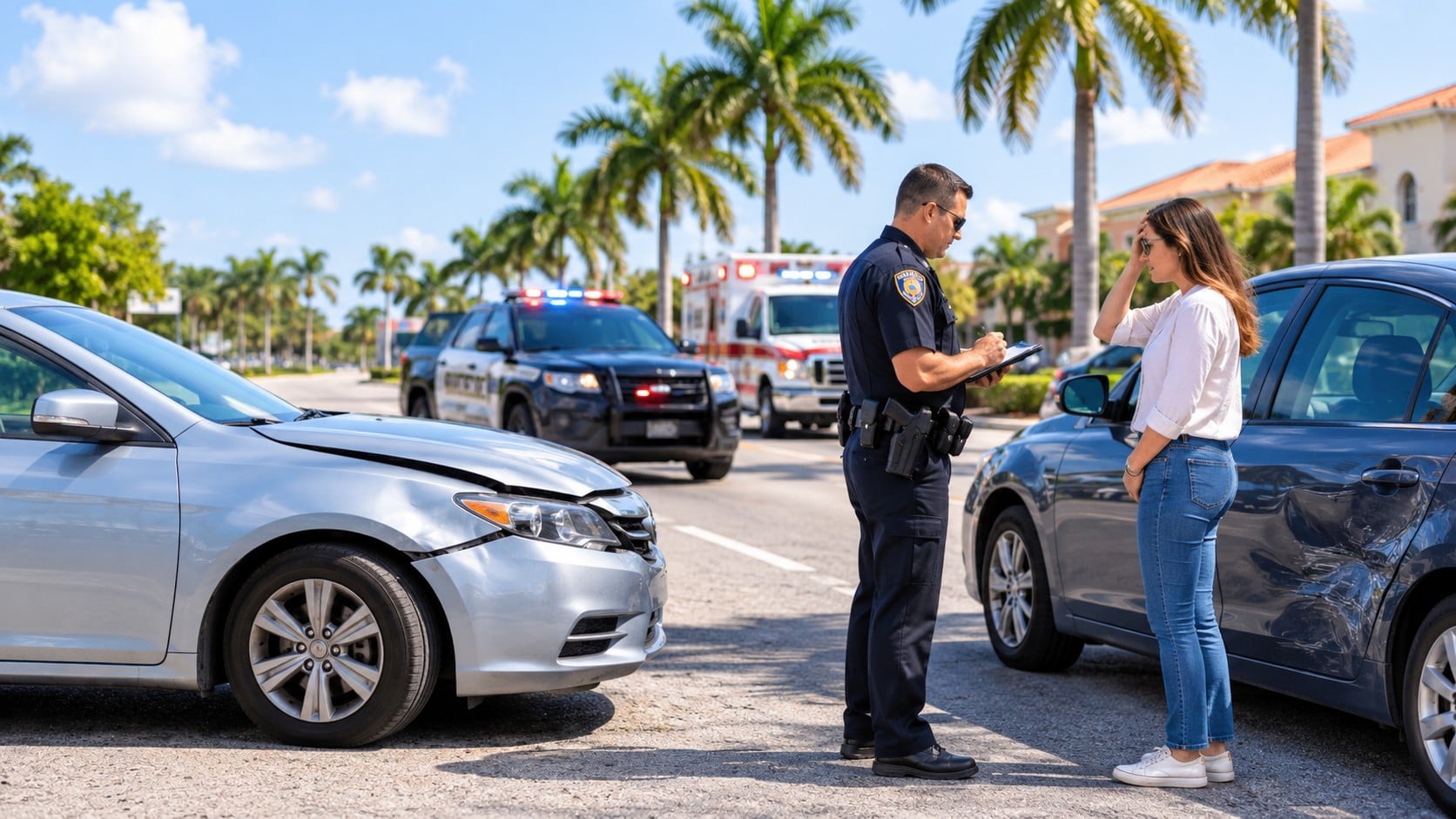
Being hit by a drunk driver is not like an ordinary car accident. You may be dealing with serious injuries, vehicle damage, and mounting medical bills while a criminal investigation unfolds alongside your own injury claim. The driver may also have little insurance, leaving you wondering where compensation will come from.
What you do in the hours and days after the crash can make a difference. Evidence of intoxication can disappear quickly, witnesses may become difficult to locate, and delays in medical treatment can complicate your claim.
If you have been hit by a drunk driver in Port St. Lucie, knowing what to do next can help protect your health and your legal rights. Here are the steps to take.
A Drunk Driver Hit Me: What Should I Do First?
The first priority is your safety. Once you are out of immediate danger, there are several steps you can take to document what happened and protect potential evidence.
Step 1: Get to Safety and Call 911
If you can move safely, get yourself and your passengers out of traffic. Do not confront the other driver or attempt to investigate whether they have been drinking. Someone who is impaired may behave unpredictably, and an argument at the scene can make an already dangerous situation worse.
Call 911 and report the accident. If you suspect the other driver is intoxicated, tell the dispatcher. Mention anything you observed, such as erratic driving, slurred speech, difficulty standing, or the smell of alcohol.
This information can help responding officers determine whether a DUI investigation is necessary.
Step 2: Tell the Responding Officer What You Observed
Your observations may become important evidence in both the criminal investigation and your injury claim.
If you noticed alcohol on the driver’s breath, slurred speech, open containers, bloodshot eyes, or erratic driving before the collision, describe what you saw. Stick to specific observations rather than guessing how much the driver drank.
Before leaving the scene, if possible, obtain the responding officer’s name, badge number, and crash report number.
Florida crash reports, officer observations, witness statements, and available breath or blood test results can help establish what happened. Some evidence may also be preserved through body camera footage, dashcam recordings, and other investigative records.
Step 3: Get Medical Attention, Even If You Feel Fine
Do not assume you are uninjured just because you can walk away from the accident.
Adrenaline can temporarily mask pain. Concussions, internal injuries, soft tissue damage, and spinal injuries may not become apparent until hours or days later.
Get evaluated by a medical professional as soon as possible, even if your symptoms seem minor.
There is also an important Florida insurance deadline to understand. Under Florida’s Personal Injury Protection (PIP) rules, you generally must receive initial medical services within 14 days of the accident to qualify for PIP benefits.
Prompt treatment protects your health and creates medical documentation connecting your injuries to the collision.
Protecting Your Claim in the Days After the Accident
Once you have addressed your immediate medical needs, the next priority is preserving evidence and understanding your insurance options.
Step 4: Preserve Every Piece of Evidence You Can
Evidence can make or break a drunk driving accident claim. Some of it may disappear within days, so start documenting what you can as soon as it is safe.
If possible, take photographs of:
- Damage to all vehicles involved.
- The accident scene, including road conditions, traffic signals, and skid marks.
- Visible injuries and bruising.
- Any debris or property damage.
- The surrounding area, including nearby businesses that may have surveillance cameras.
Get the names and contact information of witnesses. Someone may have seen the driver behaving erratically before the collision or noticed signs of intoxication at the scene.
If you learn where the driver was drinking before the accident, write down that information as well.
Florida has a limited dram shop law that can sometimes make a bar or other alcohol-serving business responsible for injuries caused by an intoxicated customer. Generally, liability may arise when a business willfully and unlawfully serves someone under 21 or knowingly serves someone habitually addicted to alcohol.
Receipts, surveillance footage, and witness accounts may help establish whether either exception applies. Because businesses do not necessarily retain surveillance footage indefinitely, preserving this evidence early can be important.
Step 5: Be Careful When Dealing With Insurance Companies
Report the accident to your own insurance company and provide the basic information requested. However, be cautious about giving recorded statements or signing settlement documents before you understand the full extent of your injuries and available coverage.
The drunk driver’s insurance company may contact you quickly. Remember that its interests are not necessarily the same as yours.
Insurance coverage is a particularly important issue in Florida DUI accidents. Florida does not generally require drivers to carry bodily injury liability coverage, which means an impaired driver may have little or no insurance available to compensate an injured person.
Your own uninsured/underinsured motorist (UM/UIM) coverage may become an important source of recovery.
An attorney can review your insurance policies, identify potentially applicable coverage, and help determine whether additional parties may share responsibility for the crash.
Step 6: Understand Your Rights as a Crime Victim
When a drunk driving accident causes physical injuries, you may also have rights under Florida’s constitutional protections for crime victims.
These rights can include:
- Receiving notice of important criminal court proceedings.
- Being present at applicable hearings.
- Having an opportunity to be heard during certain plea and sentencing proceedings.
- Seeking restitution from the offender for qualifying losses.
Restitution is separate from a civil personal injury claim. A criminal court may order the defendant to repay certain expenses resulting from the offense, although collecting that money can present a separate challenge.
You may also qualify for assistance through Florida’s Crime Victim Compensation Program, administered by the Attorney General’s Office. Depending on eligibility, the program may help cover qualifying expenses related to DUI injuries.
Applications generally must be filed within one year of the crime, although exceptions may apply.
A victim advocate through the State Attorney’s Office can help explain your rights and the application process.
How a Florida Drunk Driving Accident Claim Works
You Do Not Have to Wait for a DUI Conviction
One common misconception is that you cannot pursue compensation until the drunk driver is convicted in criminal court. That is not true.
The criminal prosecution and your civil injury claim are separate legal proceedings with different standards of proof.
In a criminal DUI case, the state generally must prove its case beyond a reasonable doubt. In a civil personal injury claim, you generally must establish liability by a preponderance of the evidence.
That means a driver may avoid a criminal conviction and still be found financially responsible for the injuries caused by the collision.
Evidence gathered during the criminal investigation, including toxicology results, body camera footage, officer testimony, and witness statements, may also help support your civil claim.
You do not necessarily have to wait for the criminal case to conclude before pursuing your own legal options.
What Compensation Can You Recover After a Drunk Driving Accident in Florida?
The compensation available depends on the severity of your injuries, the circumstances of the crash, and the insurance coverage or other assets available.
Depending on the facts, recoverable damages may include:
- Medical expenses, including emergency treatment, hospital stays, surgery, medication, and rehabilitation.
- Future medical care, such as ongoing treatment and physical therapy.
- Lost wages for the time you miss while recovering.
- Reduced earning capacity if your injuries prevent you from returning to your previous job or earning the same income.
- Property damage, covering vehicle repairs or the replacement value of a totaled vehicle.
- Pain and suffering, including physical pain, emotional distress, and other qualifying non-economic losses.
Florida’s no-fault insurance system also affects when you can pursue pain and suffering damages against the at-fault driver. Generally, you must meet the state’s serious injury threshold, which includes a permanent injury, significant and permanent scarring or disfigurement, or a significant and permanent loss of an important bodily function.
Can You Recover Punitive Damages From a Drunk Driver?
Drunk driving cases can involve an additional category of damages that is not available in every car accident: punitive damages.
Unlike compensatory damages, which are intended to reimburse victims for their losses, punitive damages are intended to punish particularly wrongful conduct and deter similar behavior.
Florida law provides an exception to its usual punitive damages limitations when the defendant’s normal faculties were impaired by alcohol or drugs, or when the defendant had a blood or breath alcohol level of 0.08 or higher.
However, punitive damages are not automatic simply because the driver was arrested for DUI. The injured person must satisfy Florida’s legal requirements for pursuing a punitive damages claim, including obtaining the court’s authorization based on an appropriate evidentiary showing.
If the evidence supports the claim, punitive damages may substantially increase the potential value of a case.
There is another important consideration: whether the award can actually be collected. Insurance generally cannot cover punitive damages imposed directly against the person responsible for the misconduct. The driver’s personal assets and other available sources of recovery may therefore matter considerably.
Can the Drunk Driver Blame You for the Accident?
Yes. Even when the other driver was intoxicated, the insurance company or defendant may argue that you contributed to the collision.
Florida follows a modified comparative negligence system. Your compensation can be reduced by your percentage of responsibility. If you are found to be more than 50% responsible, you generally cannot recover damages under the state’s comparative fault rules.
For example, if your damages total $100,000 and you are found 20% responsible, your potential recovery would be reduced to $80,000.
An impaired driver’s conduct is important evidence, but it does not automatically eliminate the need to establish how the accident happened and whether anyone else contributed to it.
How Long Do You Have to File a Drunk Driving Accident Lawsuit?
Deadlines matter, even when the criminal case is still pending.
For most negligence claims involving accidents that occurred on or after March 24, 2023, Florida generally provides two years from the date of the accident to file a lawsuit.
Certain exceptions may apply, and different deadlines can govern other types of claims.
Do not assume you have plenty of time simply because the lawsuit deadline has not arrived. Witness memories fade, surveillance recordings are overwritten, and important evidence may become harder to obtain.
Preserving evidence and evaluating your legal options early can make a meaningful difference.
When Should You Contact a Drunk Driving Accident Attorney?
Drunk driving injury claims often involve more complications than ordinary auto accident claims. There may be a parallel criminal investigation, questions about insurance coverage, potential punitive damages, and even a business that shares responsibility for serving the driver alcohol.
An attorney can help investigate the collision, obtain available criminal case records, identify applicable insurance policies, preserve evidence, and evaluate all potential sources of compensation.
If you are researching your options, our guide to filing a personal injury claim can help explain how the process typically moves from initial documentation through settlement negotiations.
For people injured in Port St. Lucie and throughout the Treasure Coast, working with a drunk driving accidents attorney familiar with St. Lucie County courts and Florida personal injury law can help ensure that important issues are not overlooked.
The earlier you understand your options, the better positioned you may be to protect your claim.
Frequently Asked Questions About Drunk Driving Accidents in Florida
What should I do first after being hit by a drunk driver? Get to safety, call 911, and tell the dispatcher if you suspect the other driver is impaired. Cooperate with responding officers, seek medical attention, and document the scene if you can do so safely.
Does the drunk driver have to be convicted before I can file an injury claim? No. A civil personal injury claim is separate from the criminal DUI prosecution. You may pursue compensation even if the driver is never convicted, provided you can establish civil liability.
What compensation can I recover after a drunk driving accident? Depending on your injuries and the circumstances, compensation may include medical expenses, future treatment, lost wages, reduced earning capacity, property damage, and pain and suffering. Punitive damages may also be available in qualifying cases.
Can I seek punitive damages against a drunk driver? Possibly. Florida law provides an exception to its usual punitive damages limitations for certain injuries caused by an impaired defendant. However, you must meet the legal requirements for pursuing punitive damages, and the court must authorize the claim.
Should I see a doctor even if I feel fine after the accident? Yes. Some injuries, including concussions and internal injuries, may not produce immediate symptoms. Florida’s PIP rules generally require initial medical treatment within 14 days of the accident to qualify for benefits.
How long do I have to file a drunk driving accident lawsuit in Florida? For most negligence claims involving accidents on or after March 24, 2023, the deadline is two years from the accident date. Exceptions may apply, so it is important to have your specific circumstances reviewed.
Can I recover compensation if the drunk driver has no insurance? You may still have options. Your own uninsured/underinsured motorist coverage, other potentially responsible parties, and the driver’s personal assets may provide additional avenues for recovery.
Talk to an Attorney Before Dealing With the Insurance Company
A drunk driving accident can leave you facing painful injuries, unexpected expenses, and a legal process that involves both criminal and civil proceedings. You should not have to figure out every part of that process on your own.
If an impaired driver injured you in Port St. Lucie, Fort Pierce, or elsewhere on Florida’s Treasure Coast, Dadan Law Firm can help you understand your legal options.
Call Dadan Law Firm at 772-263-7417 or reach us online for a free consultation. Our personal injury attorneys can review the circumstances of your accident, explain the potential sources of compensation, and help you determine the next steps.
You pay no attorney’s fees unless we recover compensation for you.